Showing posts with label Whooping Cranes. Show all posts

Foam Lake Birding No. 183


FOAM LAKE BIRDING
No. 183
            The warm summerlike weather has cooled and to the chagrin of many the rains have come.  We had a late spring and now it looks like we are getting a late fall.  As of this writing we finally have had our first frosts but most of the leaves are still on the trees.  Moreover, the skies around here seem to have a constant flow of waterfowl. 
            Although most waterfowl breed locally Sandhill Cranes do not.  They nest further north in bogs and marshes.  Prior to the arrival of Europeans Sandhill Cranes and Whooping Cranes apparently nested throughout the prairies.  Perhaps they will do so again.  At present they are common here only in the spring and fall during their migration to and from their wintering grounds in the southern US and central Mexico. 
            Sand hill Cranes were somewhat scarce until the 1950s when their numbers started to expand.  By the late 1960s a short hunting season (from September 1 to the second Saturday in September) was opened.  Even with new hunting pressure the population has continued to grow and presently the hunting season is open from September 1 to December 31 annually.  In addition, Sandhill Cranes are hunted during the winter in places like Arizona and New Mexico. 
            There are all kinds of derogatory stories out there about the palatability of the Sandhill Crane.  Having eaten a variety of species of goose, duck and grouse and even coots I found that the Sandhill Cranes are the most palatable of the bunch.  However, perception is a powerful force and prejudices die hard. 
            The Sandhill Crane is one of our tallest birds with a mature male standing over four feet high.  Colour varies from a whitish-grey to a dark grey with juveniles being quite brown.  Adults have white chin straps much like Canada Geese and naked red foreheads which has resulted in them being incorrectly called  "wild turkeys" by some people.  In flight the neck is stretched straight out like a goose or duck but much longer.  When flying it flaps its wings with a quick smart distinctive upstroke which could be described as flipped or snapped upwards. 
            There are two subspecies of Sandhill Cranes in Canada, the Lesser and Greater.  The Lesser nests on the Tundra while the Greater nests in bogs and marshes south of the Boreal Forest.  Except for size, the three foot Lesser and four foot Greater are very similar in all respects.  Both are territorial when breeding but band together in large flocks for migration unlike their close relative the Whooping Crane that is territorial all year round. 
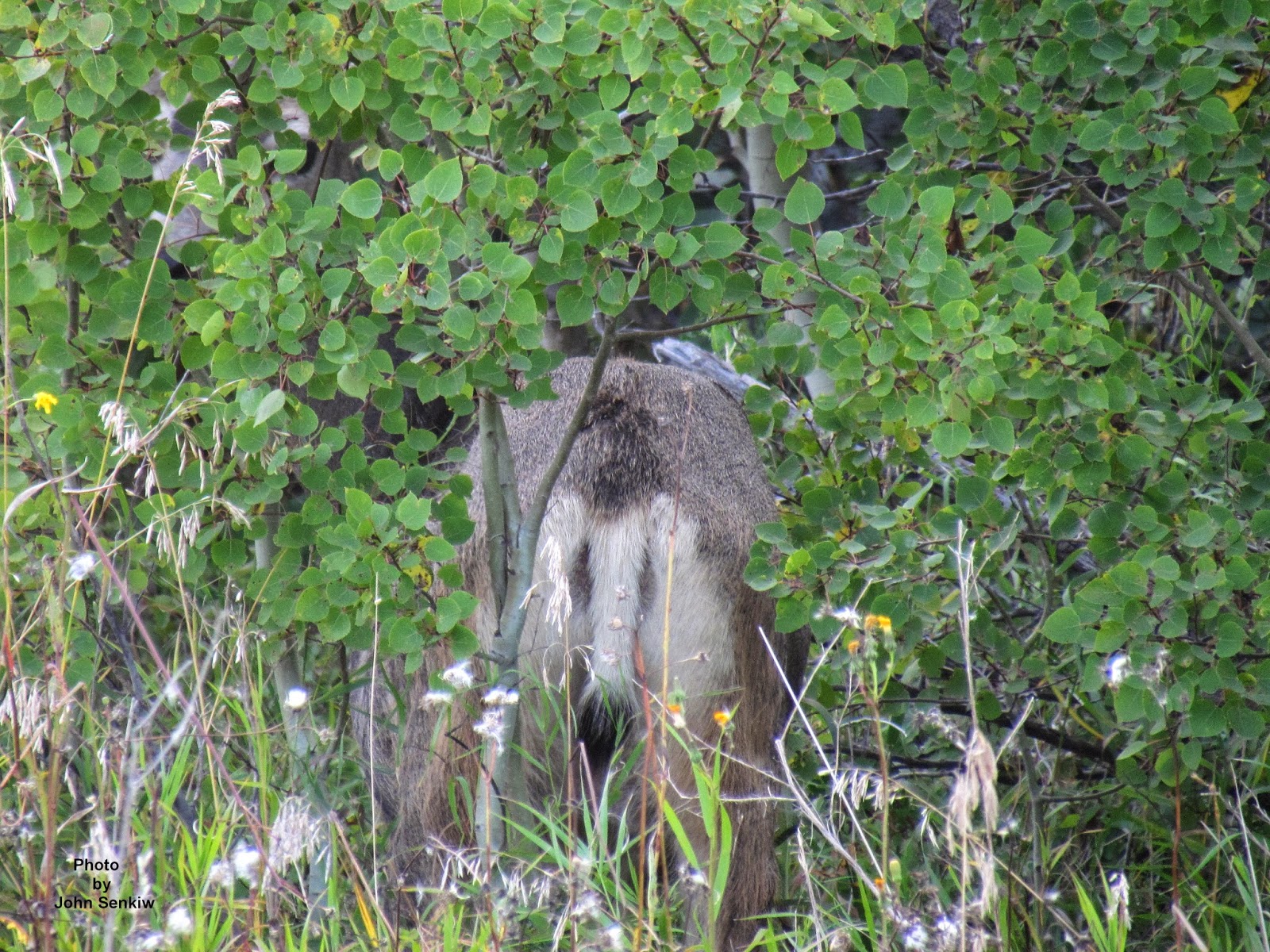
            I took this week's photo several weeks ago just north of Foam Lake.  On the way home while driving on highway 310 we had to stop for a doe refusing to move off the road.  While waiting for her to move we noticed some movement in the ditch near the car and saw three fawns standing there looking at us.  Cute.  I tried to get a picture but they were skittish and bounded away into the bush on stiff legs the way only a Mule Deer does.  I tried to get a picture of the doe but all I got was her behind as she disappeared into the bush after her young.  So, this week's photo also includes a Mule Deer's backside.  Enjoy.
 

Foam Lake Birding No. 100


FOAM LAKE BIRDING
No. 100
It is hard to believe that this is already my hundredth article on birds. To mark the event I wanted to write about our official provincial bird emblem, the Sharp Tailed Grouse, but I have not seen one for several years plus I do not have a picture of one. Therefore, plans had to change.
As luck would have it something extraordinary happened that provided me with a topic. Two adult Whooping Cranes were reported to be feeding north of Sheho on the Invermay grid road. My wife and I drove out there for three days in a row and for all three days the Whoopers were there in the same slough. Unlike Sandhill Cranes that often feed in fields, Whoopers are pure carnivores feeding on items like crabs, crayfish and frogs (no fish),and therefore are almost always near water. I took about forty pictures but none of them turned out very sharp. The distance was in the 800 metre range and I simply did not have enough camera to get good quality shots, but good enough to positively identify the birds. In comparing size the cranes certainly dwarfed the Canada Geese scattered around them. I was lucky enough to catch the cranes "dancing" something which is usually part of the spring courtship ritual. Perhaps these two were practising for spring? Most likely they were simply releasing some pent up energy. The black wing tips do stand out and are diagnostic but are only visible when the wings are extended. For a more detailed review of the Whoopers see Article No. 35.
On the way home after the first day of viewing cranes, we saw two moose fairly close to the Trans-Canada highway between Sheho and Tuffnell so we stopped and took some pictures. The quality of the photos was much better. Even though this is a birding article I thought I would include the moose as well since their presence around here is an unusual event also, although by all accounts they seem to be getting more common.
The sighting of these two Whoopers brought to mind the very first time that I had seen them. It occurred in the spring of either 1954 or 1955 as a group of us public school kids were on our way home after school. Three large white birds with black wing tips were flying low over a field not too far off the road. By chance we had just finished studying about the plight of Whoopers in school so they were relatively easy to identify. As we watched them we discussed the field marks then continued on home as the Whoopers flew away. Of course, the next morning we reported to the teacher that we had seen Whooping Cranes. Without saying as much she absolutely did not believe us, but we persisted and created a wee bit of doubt in her mind. Without saying a word she went to the phone and phoned long distance (to the DNR as it turned out). As she talked the look of amazement that crept over her face was something to behold. The person on the other end of the line informed her that there were in fact three Whoopers in the area and that they were being monitored by the DNR. Our sighting was confirmed.
What I still find humorous about that event is that at the time the sighting was no big deal. After all, there were a reported twenty one Whoopers in total and we had seen only three, therefore there were still eighteen more out there somewhere! Now that there are about 300 Whoopers in the wild seeing just two locally is a really big deal. How age changes one's perspective on things.

John Senkiw

Foam Lake Birding No. 37


FOAM LAKE BIRDING
No. 37
Last week I implied that I would be writing only about birds of the Rio Grande Valley. Well, we went on a boat tour of the marshes of the Aransas National Wildlife Preserve and saw one of North America’s rarest and most spectacular birds – the Whooping Crane. Promise broken!
In the first half of the last century, the Whooping Crane population reached an all time low of seventeen birds – by some counts. There was serious discussion as to whether to save the cranes or let them die out. Some even proposed that the Whoopers should be killed off so that the few remaining birds could be mounted as stuffed specimens perpetuating the memory of an extinct species! This is what unintentionally happened to the Carolina Parakeet, Great Auk, Ivory Billed Woodpecker and Passenger Pigeon among others (the Ivory Billed Woodpecker is reportedly not extinct as previously thought, although there is some debate about the sightings). Fortunately, it was decided to save the cranes.
At present, there are about 500 Whoopers overall with about 300 of those in the wild. The remaining 200 are maintained in captivity and used as breeding stock to ensure the survival of the cranes in case of a disaster to the wild flock.
At present, there are two separate wild flocks. By far the largest flock nests in northern Alberta in Wood Buffalo National Park and winters in the Aransas Preserve along the coast of southern Texas. A smaller flock has been established in Wisconsin and winters in Florida. This smaller flock appears to be successful as young have been reared in the wild. Other flocks are planned, but the process is very slow. It is essential to have several migratory flocks so that if a disaster (like a hurricane) strikes, at least some of the flocks will be safe and perpetuate the species.
Unlike its smaller close cousin, the Sandhill Crane, the Whooper does not flock for migration or for any other reason. It is always territorial even on its wintering grounds, whereas, the Sandhill migrates and winters in vast flocks in the southern USA. This means that the Whoopers need vast amounts of favourable habitat for nesting and wintering. In short, habitat for its survival is not easy to procure and establish. Unless it changes its habits (like the raven or Canada Goose) it will probably never be common.
Physically, the Whooping Crane is North America’s largest bird (the heaviest is the Trumpeter Swan). It is pure white with black legs, wing tips and a kind of mask around the bill, and a bald red patch on its forehead (similar to a chicken or turkey). In flight it extends its legs backward and its neck forward. It looks like a white cross with black on all of its extremities. Once seen it is unmistakable. Males and females are identical. However, some other birds are often misidentified as Whooping Cranes. The three are: the White Pelican (neck and legs are not stretched out, but tucked in so the bird looks pudgy); the Trumpeter and Tundra Swans (wings are pure white – no black tips). .
Whoopers fiercely protect themselves and their young, and are fully capable of fending off a fox or coyote. In fact, the banding of Whoopers was discontinued because of the damage wreaked by the cranes on the banders.
This week’s picture shows a family unit of two parents and one youngster. The young one has a lot of rusty brown on it, especially on its head and neck. (I know, your picture is not coloured). The youngster is the one in the middle trying to eat a fish it has caught, but knows not how to eat it! Until next time, adios.