Foam Lake Birding No. 150


FOAM LAKE BIRDING
            We are now in sunny southern California and really enjoying all that this different climate has to offer.  Many of the plants and animals found here are unique to this and adjoining areas making it interesting for birders like us. 
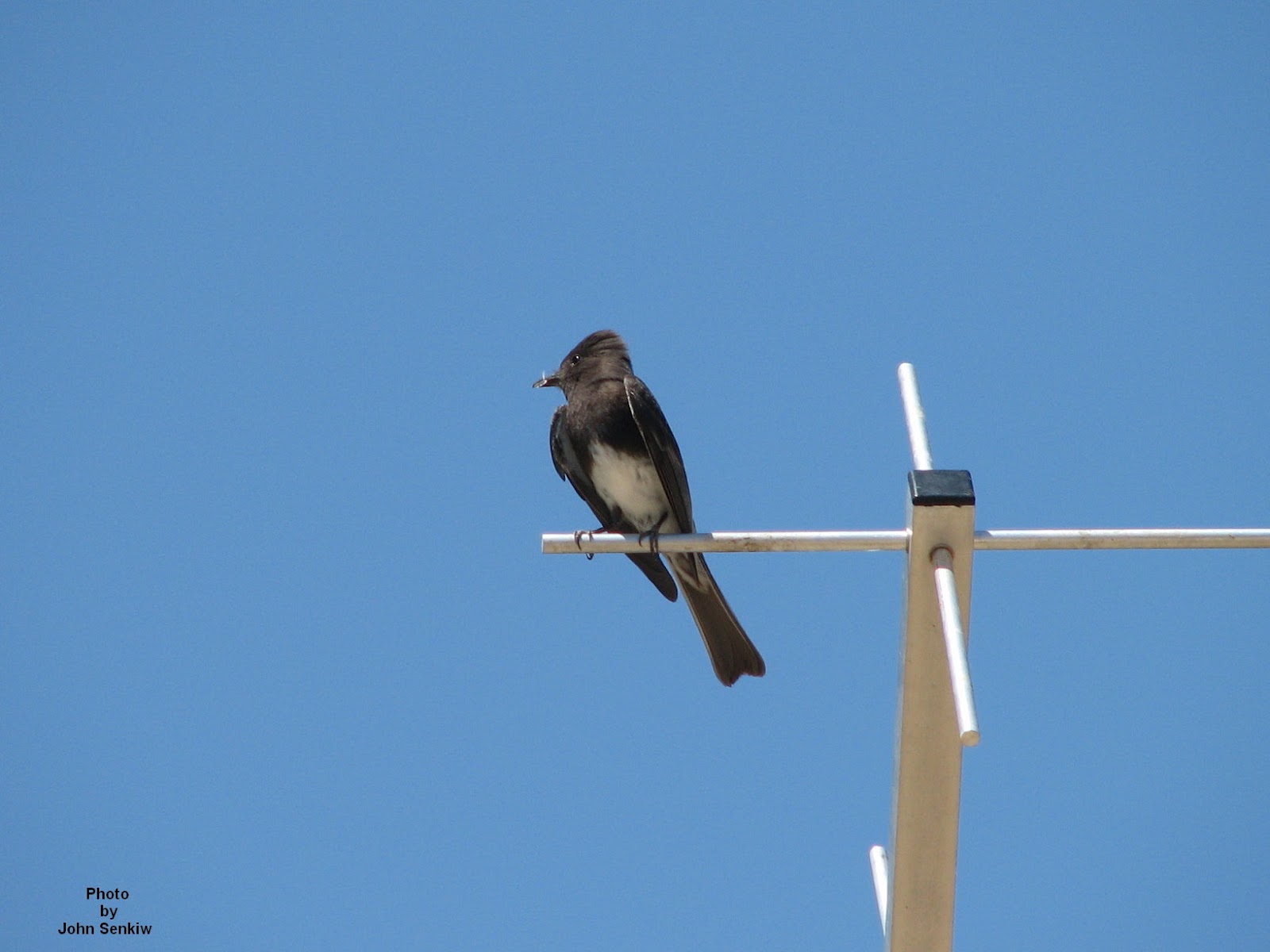
            The first day that we were here a Black Phoebe landed in a shrub in our daughter’s back yard.  It did not do very much save for sitting for a few minutes and then flying off.  Even though it did nothing exciting it did provide me with a topic for this week. 
            The Black Phoebe is common throughout the American southwest wherever there is water.  Any desert spring or stream is always surrounded by lush vegetation and a pair of Black Phoebes will almost always be present.  In short, although Black Phoebes live in desert areas, they really are not desert birds at all. 
            The Black Phoebe is a typical flycatcher sitting on a prominent perch then suddenly flying out to snag a flying insect.  When perched, Black Phoebes, like all flycatchers, sit in a very upright or erect fashion.  This characteristic is very useful in identifying flycatchers in general as most perching birds sit in a more horizontal position. 
            In terms of field marks the Black Phoebe is very easy to identify.  It is a sparrow sized black bird with a clearly defined white belly and white outer tail feathers.  The only bird that it could be confused with is the slate coloured form of the Dark Eyed Junco.  This is not very likely as the two species behave very differently. 
            Although the Black Phoebe is very common right here in Carlsbad this week’s picture was taken several years ago in Big Bend National Park in Texas. This one was sitting on a communications antenna.

Foam Lake Birding No. 149


FOAM LAKE BIRDING
No. 149
            Yesterday, we saw our first Baltimore Oriole of the year which means that the last of the summer migrants are finally here.  As yet I have not seen a Yellow Warbler nor a  House Wren but they will probably be here before this article goes into print.  We have set out grapefruit halves for the oriole and, hopefully, we have the same success in attracting the oriole as we have had in the past. 
            For the first time ever we had a male Rose Breasted Grosbeak at our black oil seed feeder.  He stayed for three days and then was gone, probably flying away to the nesting grounds in and around the Boreal Forest.  A small flock of Goldfinches have since made up for his absence. 
            As I mentioned in Article No. 92, the male Rose Breasted Grosbeak, in my opinion, is our most beautiful bird.  This time I was able to get some good photos of a male in his finest spring plumage in bright sunlight.  They turned out so well that I decided to use them in this week's article.  In black and white the grosbeak looks quite ordinary but in colour he is something else.  One picture has him at the feeder with a Harris Sparrow; the second and third have him perched in a tree nearby.  Check my website at www.johnthebirder.com to see the grosbeak in his striking colours.  
                   For the next little while we will be in southern California.  During that time I intend to write about some of the birds that are common to that area but not necessarily confined to it.                                               


Foam Lake Birding No. 148


FOAM LAKE BIRDING
No. 148
            The absentees of last week (the Harris Sparrow, Lincoln's Sparrow, Pine Siskins, Goldfinches, and Swainson's Thrush) are all here now in our yard.  Once the trees start leafing out in earnest the last of the summer arrivals like the Yellow Warbler, Baltimore Oriole and House Wren will be here.  Then it is nesting time. 
            With the warmer weather we are now sleeping with our window open to breathe the nice fresh air throughout the night.  A fringe benefit is that we also get to hear birdsong in the late evening and early morning.  Some people find this very annoying but my wife and I find it soothing. 
            One of the bird sounds that we find very relaxing is that of the Wilson's Snipe.  I used the word "sound" instead of "song' for a reason.  During the spring courting season the male flies up from his perch, and after gaining altitude, goes into a shallow dive.  After gaining speed the air passing through his tail feathers produces a hollow whistling sound best described as 'wu wu wu . . .".  He then pulls out of his dive and repeats the process.  Sometimes, instead of diving, he will fly in a straight line parallel to the ground and then suddenly turn into a flat curve with the same resulting sound.  The sound is often referred to as "winnowing".  Several males performing in the same area put on quite a performance - at least for birders.  In Eastern Canada the somewhat similar Woodcock does something much the same but less dramatic. 
            The Wilson's Snipe, a Robin sized wader, is a relatively nondescript brown and white bird with an extremely long bill.   Although it is a wader it is somewhat of an upland bird often seen sitting on fence posts, light standards and so on sometimes quite far from water. 
            In the late fall small family groups are found along edges of larger sloughs as long as the shore lines are not frozen over.  When flushed they fly away in zig zag fashion while uttering a loud and harsh "scape".  It is a game bird and for many years I tried to bag one to see how palatable it was but, no matter how hard I tried, the snipes always managed to surprise me and fly away before I could get my bearings. 
            I took this week's picture last July just south of Monmartre near the motel that we were staying at.  Judging by the amount of "white wash" on the rail it must have spent a lot of time perched on it .